
NIKKOR The Thousand and One Nights No.98
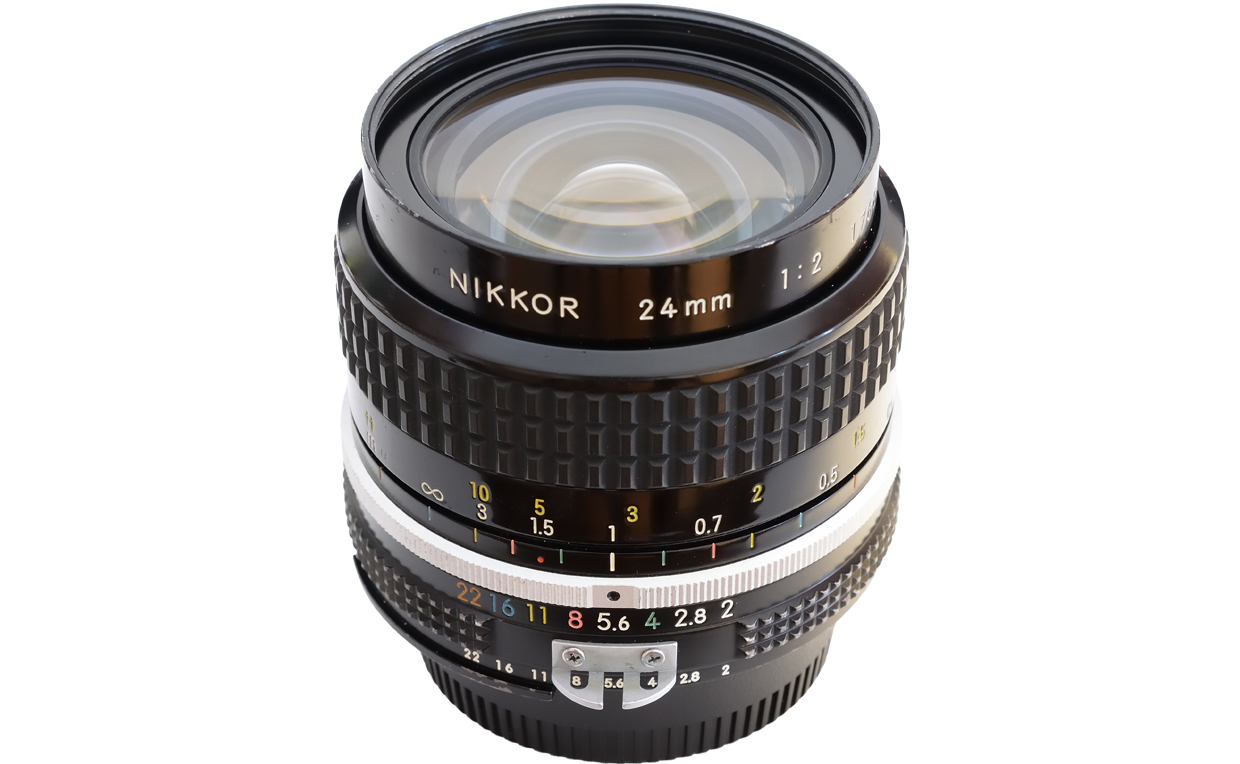
Unequaled rendering: A fast wide-angle lens for the manual focus era
Ai Nikkor 24mm F2
In this Tale, I'm going to tell you about the Ai Nikkor 24mm F2, a fast wide-angle lens released in 1977. This was the third fast wide-angle lens in the Nikkor lineup, following the Nikkor Auto 35mm F1.4 and Nikkor Auto 28mm F2, which were released one right after the other in 1971. How did Nikon's first 24mm f/2 lens come about, and how does it perform in terms of rendering?
By Kouichi Ohshita
The fast wide-angle lens series
Let's go back to 1971, the year in which the Nikkor Auto 35mm F1.4 and Nikkor Auto 28mm F2 fast wide-angle lenses were released. At that time, more than 50 interchangeable lenses were available for the Nikon F. With the release of the Fisheye-Nikkor 6mm F2.8 and the Reflex-Nikkor 2000mm F11 in 1972, the Nikkor lineup was nearly complete with coverage from 6mm to 2000mm. However, Nippon Kogaku (now Nikon) was not satisfied with the status quo and continued its efforts without complacency. Many manufacturers had entered the SLR and interchangeable lens market, creating fierce competition. It was around this time that the company expanded the use of the multilayer coating technology first introduced in the Nikkor Auto 35mm F1.4 and Nikkor Auto 28mm F2 to other lenses and, in rapid succession, also rolled out a series of exterior design changes known as the "New Type". This shift was triggered by the fact that other manufacturers began introducing multilayer coatings to their lens lineups in the early 1970s. In response to other manufacturers' release of super-telephoto lenses and broadband achromatic lenses using fluorite in the 1970s, Nippon Kogaku began expanding its ED super-telephoto lineup by incorporating the extra-low dispersion (ED) glass first introduced in the Nikkor-H 300mm F2.8, released in 1972 (as described by Sato in Tale 11), into four lenses released in 1975: the Nikkor 300mm F4.5 ED, Nikkor 600mm F5.6 ED, Nikkor 800mm F8 ED, and Nikkor 1200mm F11 ED. In this way, the company consistently aimed to maintain and expand a lens lineup that would stay ahead of its competitors. It was against this backdrop that development of the 24mm F2 began.
Teruyoshi Tsunashima
The lens was designed by Teruyoshi Tsunashima. When I joined Nippon Kogaku, Tsunashima worked in a different department, but was later assigned to the 1st Optical Section. Like me, he worked on compact cameras, so I learned a lot from him. Like Ikuo Mori, whom I introduced in Tale 64, he was also an experienced senior colleague who had worked on many designs, yet was open and gracious, treating newcomers like me as fellow optical designers on an equal footing. Shortly after Tsunashima returned to the 1st Optical Section, several designers were working on a zoom lens for compact cameras. I was in charge of the viewfinder, examining zoom viewfinder structure and benchmarks for optical performance based on design materials from predecessors like Zenji Wakimoto and Soichi Nakamura, as well as prototypes still in existence. Although rangefinder cameras had already become a thing of the past, the external zoom viewfinders being produced at the time, as well as prototypes of next-generation rangefinder cameras intended to replace the Nikon SP, proved extremely valuable as design references. The external zoom viewfinder for the Nikon S was designed by Wakimoto, and the next-generation rangefinder camera was designed by Nakamura; remarkably, it was a real-image zoom viewfinder. The key design considerations and performance criteria for optical systems for the human eye, including viewfinders, are quite different from those for photographic lenses. I was able to proceed with the design of my first compact camera zoom viewfinder and real-image viewfinder without losing my way, thanks to the fact that the designs of these predecessors were still available. Unfortunately, the next-generation rangefinder camera was never released, but its design remains in the viewfinders of film and digital compact cameras such as the Pikaichi Zoom (TW Zoom QD), Pikaichi Zoom 35-70 QD (TW Zoom 35-70 QD), and COOLPIX 900.
But I digress. I was talking about Tsunashima, who was also involved in the design of the Pikaichi Zoom. In the early stages of this new zoom design, when I asked him about the approach he was taking, I found that he was breaking the zoom down into individual blocks and examining how aberrations arose by altering the light paths within each block. He said that it was his first time designing a zoom lens, and that he therefore wanted to start by seeing how aberrations were generated and balanced within each group. By this time, advances in automated design and computer technology had made it possible to design even complex zoom lenses to a certain extent using automated methods. However, Tsunashima pursued a design he could be satisfied with, advancing the work while clarifying the optical roles of each lens group and element. Tale 13 of NIKKOR The Thousand and One Nights includes a larger-than-life anecdote about Tsunashima, but he was a meticulous designer who considered each piece of the optics puzzle and found exactly where they fit.
Ai Nikkor 24mm F2
While there is no clear record, it is thought that Tsunashima began designing this lens around 1973. The design was completed in 1974. The first prototype was produced that summer, but it did not perform well. As a result, the curvature of each lens element was corrected and the design revised. The second prototype was produced in the spring of 1975 and passed testing. In January of 1976, the order for mass production was issued, and the Ai Nikkor 24mm F2 was released in October of 1977. More than a year and a half passed between the order for mass production being issued and the release of the lens. This is thought to have been because Nippon Kogaku was making the switch from "New" Nikkor lenses to Ai Nikkor lenses at the time, and carefully timing the release of the new lenses.
Lens construction
Fig. 1 is a cross section of the Ai Nikkor 24mm F2.
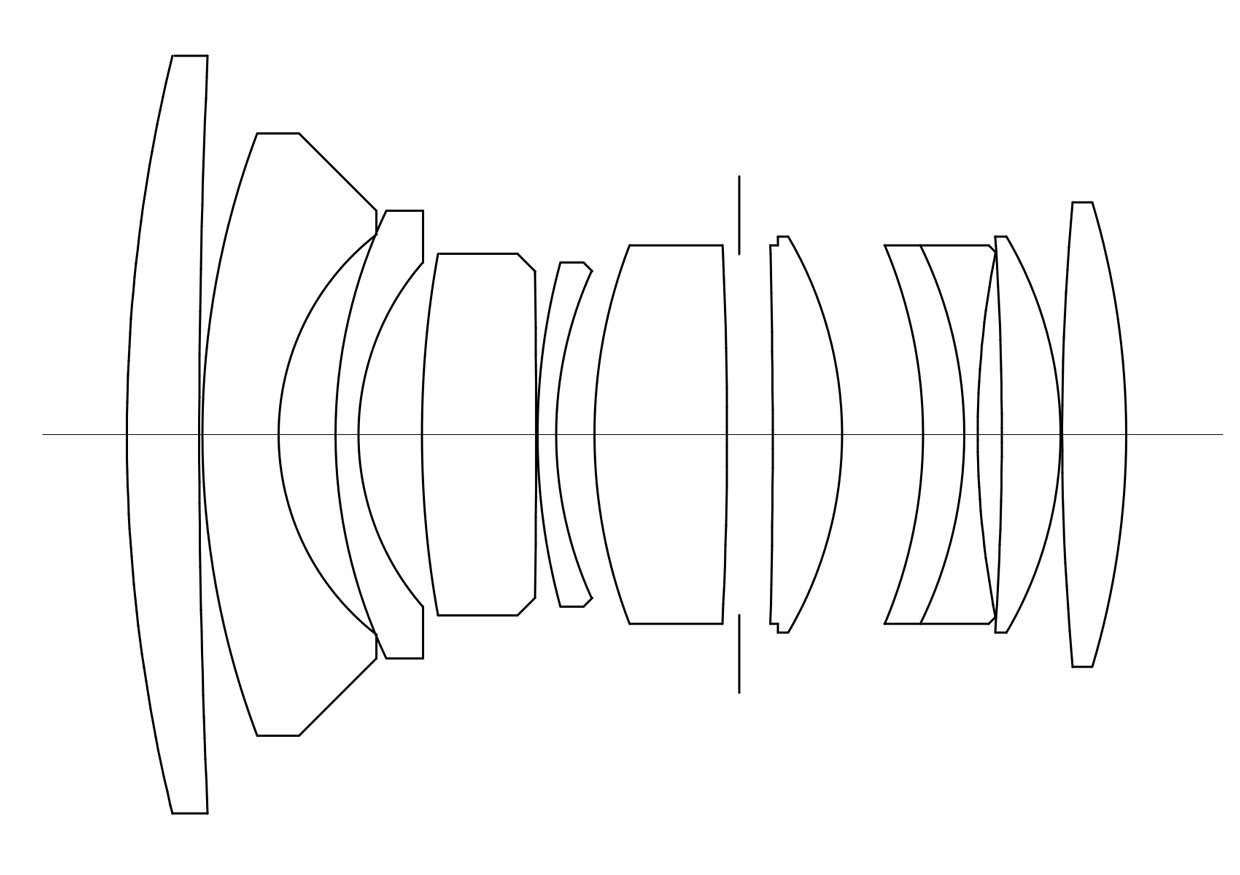
This lens has a retrofocus configuration made up of a concave front group and a convex rear group, but its complex 11-elements-in-10-groups design makes the separation between the front and rear groups unclear. For convenience, let's consider the first four lens elements the concave front group and the seven elements that follow the convex rear group. It is easier to understand the characteristics of this lens structure if it is compared to the Ai Nikkor 24mm F2.8 introduced in Tale 86. While the curvature radii of each lens element are quite different, there are many similarities in the basic arrangement of the elements. Lens elements in the front group have the same convex-concave-concave-convex structure as the 24mm F2.8, the differences being the addition of a concave meniscus lens at the front of the rear group (fifth lens element) and the use of a cemented doublet for the concave elements behind the aperture. The fast-aperture, wide-angle 24mm configuration was achieved through the generation and balancing of high-order aberrations between the concave meniscus element (No. 5) and the convex element following it (No. 6), together with the effect of a cemented doublet behind the aperture.
The most notable rendering characteristic of the Ai Nikkor 24mm F2 is, without a doubt, the large amount of sagittal coma flare it produces. Sagittal coma flare tends to increase as the focal length decreases and aperture speed increases. As I said at the beginning, there were three fast-aperture, wide-angle lenses available at the time-the Nikkor Auto 35mm F1.4, the Nikkor Auto 28mm F2, and this Ai Nikkor 24mm F2. The Nikkor Auto 55mm F1.2 had also been released as a fast-aperture standard lens. All of these lenses exhibit a significant amount of sagittal coma flare, but if one were to rank them, the Ai Nikkor 24mm F2 shows the greatest amount, followed by the Nikkor Auto 35mm F1.4, then the Nikkor Auto 55mm F1.2, with the Nikkor Auto 28mm F2 showing the least. This ranking may be considered an indication of the relative difficulty of their design. Sagittal coma flare causes images to be softer at the edges of the frame when shooting at maximum aperture. Further, as is frequently mentioned in these Tales, sagittal coma flare decreases greatly when the aperture is stopped down, allowing different rendering characteristics to be enjoyed at various aperture settings.
The cause of this sagittal coma flare lies in the small radii of curvature of the second, third, and fifth concave meniscus lens elements, which were required to reduce the size of the front element to fit within a 52mm filter-attachment size. Tsunashima was aware of this shortcoming and later designed an improved version with the same basic specifications. However, the design was not put into mass production because it required a greater number of lens elements and did not conform to a 52mm filter-attachment size. This shows how particular Nikon was to filter-attachment size at the time.
The Ai Nikkor 24mm F2 exhibits slightly more distortion than the Ai Nikkor 24mm F2.8, but is on par with that exhibited by the Nikkor Auto 24mm F2.8 and therefore may not be particularly noticeable. Furthermore, it's worth noting that except at the corners of the frame, the lens exhibits minimal astigmatism for a wide-angle lens, resulting in stable, straightforward rendering with little image instability across different focus positions. However, a slight curvature of field remains, so precise focusing on the intended subject is vital.
Lens rendering
As always, let's take a look at the rendering characteristics of this lens. The sample images for this Tale were captured using the full-frame Z6 and Z8 mirrorless cameras with the FTZ mount adapter. Please excuse the usual note, but when a manual focus lens is used with the FTZ, shooting is performed with actual aperture metering but the focal length and maximum aperture must be registered with the camera. It is important to register the focal length for effective use of on-board vibration reduction. The Z6 supports registration of only focal length and aperture, but the Z8 supports registration of the lens name as well for added convenience.
The following samples were captured in RAW format and processed with lateral chromatic aberration correction and vignette control disabled.

Z8 + FTZ w/ Ai Nikkor 24mm F2
At maximum aperture, shutter speed of 1/400 s, ISO 64; processed with NX Studio

Z8 + FTZ w/ Ai Nikkor 24mm F2
At aperture setting of f/8, shutter speed of 1/50 s, ISO 64; processed with NX Studio
Samples 1 and 2 are distant landscapes of a river valley with fall colors. Sample 1 was captured at maximum aperture and Sample 2 with the aperture stopped down to f/8. At maximum aperture, Sample 1 exhibits clearly defined leaves at the center of the frame, but there is some flare, resulting in low contrast. A gradual decrease in resolution and increase in flare is visible from the center of the frame to the edges. A significant amount of flare at the corners of the frame results in quite soft rendering, but overall, the image holds together without any serious flaws. It does exhibit a noticeable amount of peripheral illumination falloff (vignetting), which is not visible in Sample 2 captured at f/8. This peripheral illumination falloff is almost completely eliminated by stopping the aperture down to f/4.
On the other hand, flare is completely eliminated, even at the extreme corners of the frame, in Sample 2 captured at f/8, for a sharper, cleaner image. The smaller aperture also eliminates the peripheral illumination falloff visible in Sample 1. Furthermore, while resolution at the edges of the frame has improved noticeably, there remains a gradual falloff in resolution toward the periphery, resulting in a mild rendering that is consistent with the tendency seen in Sample 1. This is due to a slight amount of residual field curvature, which causes the periphery of the frame to be focused slightly closer than the center. Therefore, while the autumn leaves at lower right in the image are relatively sharp, the mountains in the background and the building in the upper right corner exhibit softer rendering. In both Samples 1 and 2, focus was placed on the leaves at the center of the frame; however, even when shooting distant scenes or stopping down the aperture, it is important to make a point of focusing on the intended subject.
If you look at the edges of the building in the upper right corner and the outlines of stones in the riverbed at the lower left, you can see green and magenta color fringing caused by residual lateral chromatic aberration. This color fringing is not visible at all in straight-out-of-camera JPEG images, or when lateral chromatic aberration correction is enabled using its default setting during RAW processing. As a matter of fact, this lateral chromatic aberration is also visible in Sample 1, which was captured at maximum aperture; however, coma from each color, which gives rise to flare, tends to overlap and effectively cancel out, making the color fringing less noticeable.

Z6 + FTZ w/ Ai Nikkor 24mm F2
At aperture setting of f/4, shutter speed of 15 s, ISO 3200; processed with NX Studio
Z8 + FTZ w/ Ai Nikkor 24mm F2
At aperture setting of f/5.6, shutter speed of 1/25 s, ISO 450; processed with NX Studio
Sample 3 is a photo of the Milky Way in summer captured at f/4. By shooting in vertical orientation, I was able to include Ophiuchus, Scorpius, and Sagittarius in a single composition. A similar image can be found in Tale 96, where multiple images were combined to increase contrast. In contrast, this image is a single shot and was processed with more moderate contrast. As shown here, using a wide-angle lens of around 24mm or wider to capture various constellations along with the landscape makes astrophotography especially enjoyable. The stars at the center of the frame appear slightly elongated, but this is because the shot is a 15-second exposure captured with the camera mounted on a tripod. To minimize this elongation of the stars, the exposure would need to be reduced to 8-10 seconds; however, even at ISO 3200, a 15-second exposure was already insufficient, so this was unavoidable.
This lens is prone to a significant amount of sagittal coma flare. When photographing the night sky at maximum aperture, sagittal coma flare results in a swirling, concentric pattern around brighter stars at the edges of the frame. Stopping down the aperture to f/2.8 reduces this flare in the center half of the frame, but not in the outer half of the image. As you can see in Sample 3, stopping down the aperture to f/4 results in almost perfectly round star points except at the extreme corners of the image, and vignetting is almost completely eliminated. However, the bright stars don't stand out as much because the flare around them has disappeared, making the image look somewhat dull. Opening up the aperture slightly to around f/2.8 might have preserved the flare around the bright stars for a more impressive image. Like the Ai Nikkor 35mm F1.4S featured in Tale 27, the look of the image changes dramatically with even a half- or one-stop adjustment with this lens. You may want to find the aperture setting that best suits your preferred rendering.
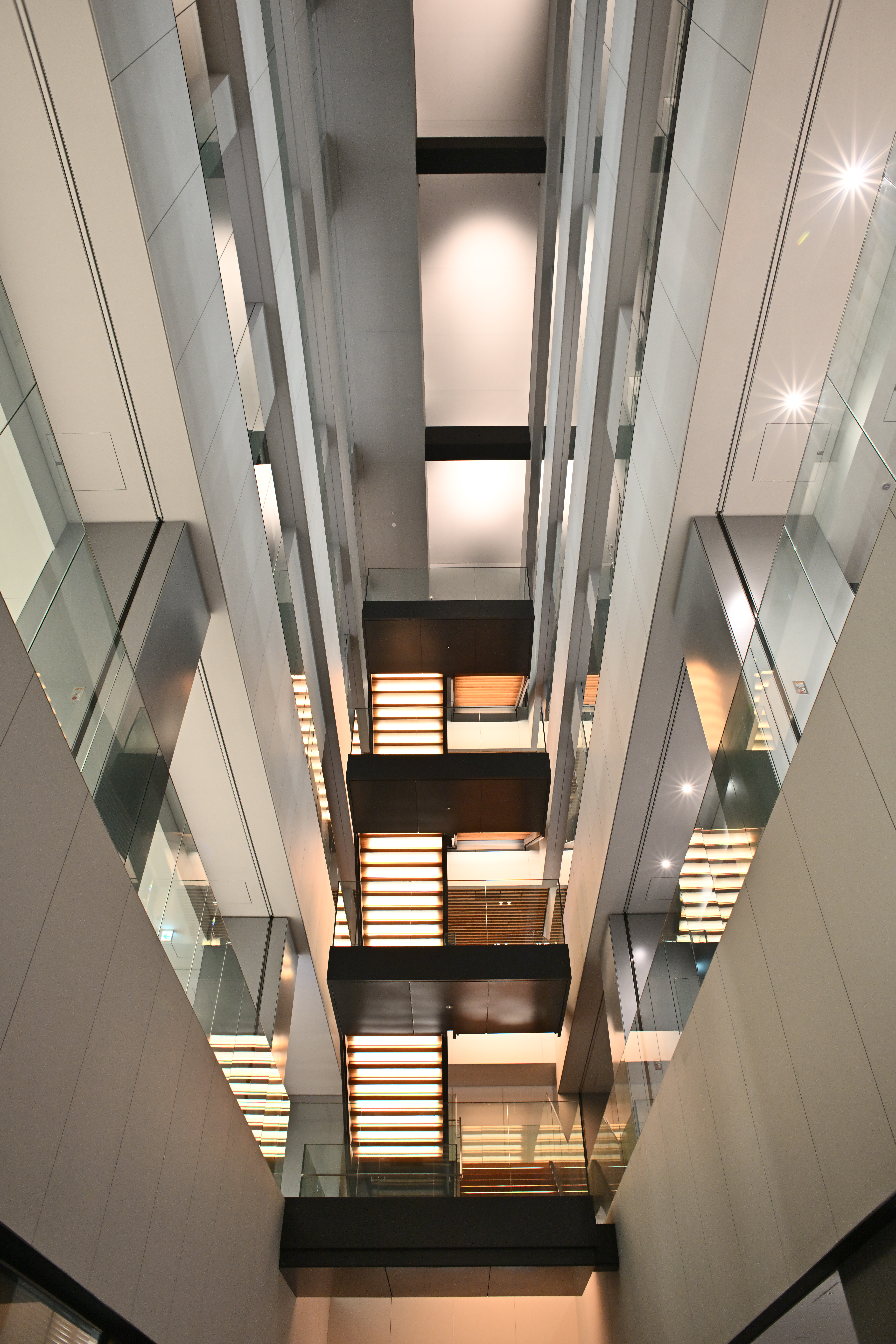
Sample 4 is a photo of a building's atrium with the aperture stopped down to f/5.6. As objects at the edges of the frame are generally closer to the camera than those at the center, the image is sharp and clear all the way to the extreme edges. Although the scene contains many straight lines, distortion is not particularly noticeable. While lateral chromatic aberration is noticeable at the edges of the frame, as explained in Sample 2, it can be minimized by enabling lateral chromatic aberration correction during RAW processing.
Z6 + FTZ w/ Ai Nikkor 24mm F2
At maximum aperture, shutter speed of 1/800 s, ISO 100; processed with NX Studio
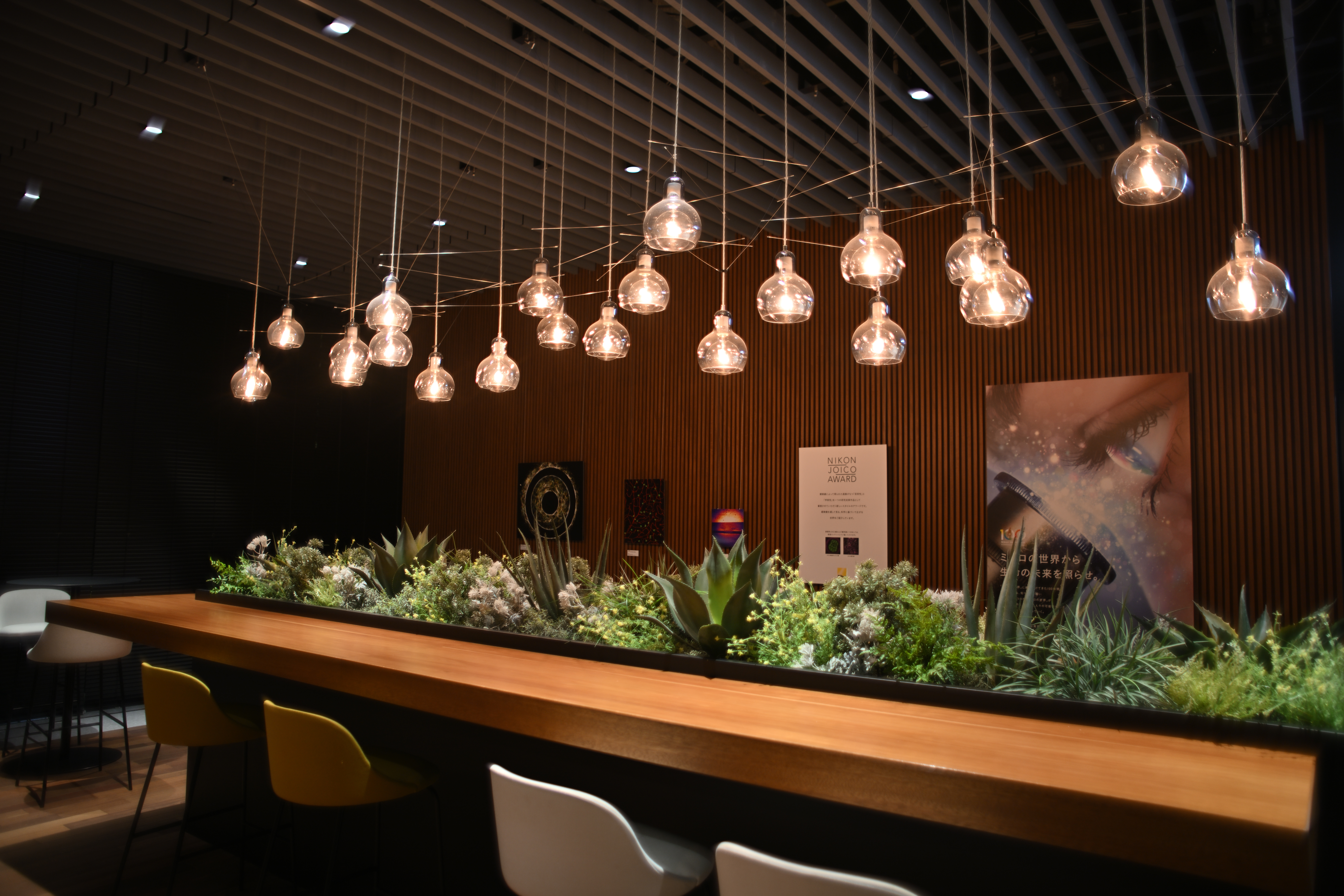
Z8 + FTZ w/ Ai Nikkor 24mm F2
At maximum aperture, shutter speed of 1/40 s, ISO 64; processed with NX Studio
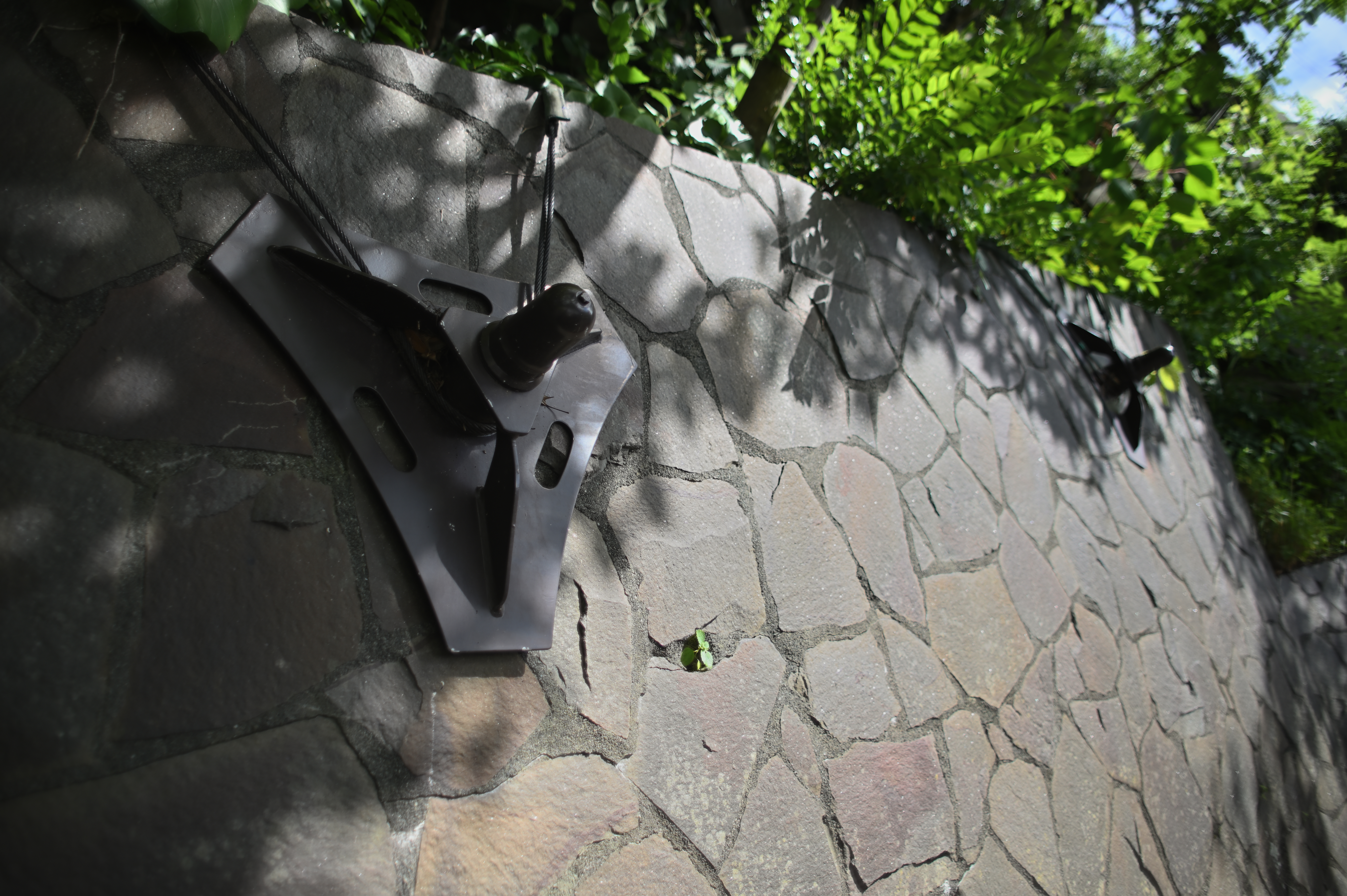
Sample 5 was captured at maximum aperture because the shape of the anchor structure in the stone wall caught my eye. The shooting distance for this image was just under one meter. I focused on the tip of the projecting rod on the left. Even at maximum aperture, the metal fitting in focus is rendered sharply, and its texture comes through well. As you shift your gaze from the in-focus subject on the left to the right, you'll see how the stone wall is smoothly and naturally blurred. However, you can see vertical streaks of light at the tip of the rod on the right. This is the characteristic shape of bokeh for lenses that exhibit a great deal of sagittal coma flare. It can also be seen in the highlighted areas of the distant plant at the upper right of the frame. When magnified, these faint streaks of light make the bokeh look a little strange, but they don't really bother me. If they bother you, they could be eliminated by stopping down the aperture to f/2.8.
Sample 6 was captured at maximum aperture in a warmly lit interior. If you look at the rows of lights, you can see that even the lights near the center of the frame show some flare. As your gaze moves toward the edges, larger, ribbon-shaped flare caused by sagittal coma becomes increasingly noticeable. However, if you focus on the metal fittings of the lights, the edges remain sharp, indicating that the resolution is still excellent. As shown here, when it works well, sagittal coma flare does not become distracting, but rather helps to achieve unique image rendering. You can also see that details in the background wall and on the foreground table are well preserved, suggesting that this fast lens is quite forgiving when it comes to focus.

Z6 + FTZ w/ Ai Nikkor 24mm F2
At maximum aperture, shutter speed of 1/1250 s, ISO 100; processed with NX Studio

Z8 + FTZ w/ Ai Nikkor 24mm F2
At maximum aperture, shutter speed of 1/500 s, ISO 64; processed with NX Studio
Sample 7 is a photo of bush clover flowers beginning to bloom in midsummer, captured at maximum aperture. Thanks to this lens's large f/2 maximum aperture, the background is beautifully blurred, and the flowers themselves are delicately rendered with a subtle veil of flare. If you look closely at the background bokeh, can you see that it appears to radiate? This can also be seen in Sample 5, in which bokeh is distorted into an egg shape. This characteristic is inherent in wide-angle lenses equipped with the close-range correction system. It was explained in Tale 84, which introduced the Ai Nikkor 35mm F2S, but I'll explain it again. The close-range correction system corrects the effects of curvature of field and astigmatism, aberrations that are quite common with wide-angle retrofocus lenses, with close-up shooting. The system enables good image formation for flat subjects captured at close distances. However, this lens is optimized for flat image formation at close distances. As a result, at infinity (in the background bokeh), curvature of field and astigmatism come into play, producing distorted bokeh that appears to radiate.
This bokeh distortion can be reduced somewhat by stopping down the aperture, becoming much less noticeable at f/4. It cannot, however, be completely eliminated, so I hope you can appreciate it as an interesting characteristic of this lens.
Sample 8 is of autumn maple leaves shot at close range at maximum aperture. Considering the background bokeh distortion in Sample 7, I took care to ensure the subject at the center of the frame was well lit and there were no bright background objects standing out at the edges of the frame. As a result, the way background bokeh flows isn't noticeable, despite having been captured at maximum aperture. In addition, the vignetting that occurs at maximum aperture helps to enhance the autumn leaves at the center of the frame.
Unequaled rendering
The Ai Nikkor 24mm F2 was released in October of 1977 and gained popularity as a compact, fast 24mm lens. In 1981, it was redesigned and released as the Ai Nikkor 24mm F2S, and it was among the lenses that continued to be sold even after autofocus SLRs became the norm with the release of the F-501 in 1986. The lens remained in production for an impressive 29 years, until its discontinuation was announced in January 2006. As I mentioned earlier regarding Tsunashima's redesign efforts, it is not that no attempt was made to redesign the lens during its production run. In 1982, Daijiro Fujie also worked on an improved design for this lens, and prototype development extended into 1983. Evaluation results for the prototypes showed good performance, but unfortunately, mass production was put on indefinite hold. This is pure speculation, but perhaps they were focusing on the development of autofocus SLRs at the time, and plans to improve existing lenses were therefore not pursued. I personally think it a great pity that Fujie's lens was never released, especially since it offered significant improvements to curvature of field at the edges of the frame and sagittal coma flare, both of which had been issues with the original lens.
In this NIKKOR The Thousand and One Nights series, as for 24mm lenses, the Nikkor-N Auto 24mm F2.8 was featured in Tale 14 and the Ai Nikkor 24mm F2.8 in Tale 86. However, this Ai Nikkor 24mm F2 has a distinctive character all its own, setting it apart from both. The soft rendering veiled in flare from maximum aperture to f/2.8 is especially unique and not available with ordinary wide-angle lenses. While the Ai Nikkor 24mm F2.8 offers attractively high-contrast rendering even at maximum aperture, the softer rendering of this lens has its own appeal. So is the incredible speed of f/2 wasted on those who want sharp rendering for astrophotography and the like, and will be stopping down the aperture anyway? I don't think so. As I explained in the sample images in Tale 86, it is necessary to stop down to f/5.6 to eliminate sagittal coma flare with the Ai Nikkor 24mm F2.8. With the Ai Nikkor 24mm F2, however, it is almost completely eliminated at f/4 (see Sample 3). Therefore, the extra stop of speed is a clear advantage. The lens is a little finicky, but when it works well, it produces beautiful images, and its soft rendering is truly soothing.
NIKKOR - The Thousand and One Nights
The history of Nikon cameras is also that of NIKKOR lenses. This serial story features fascinating tales of lens design and manufacture.